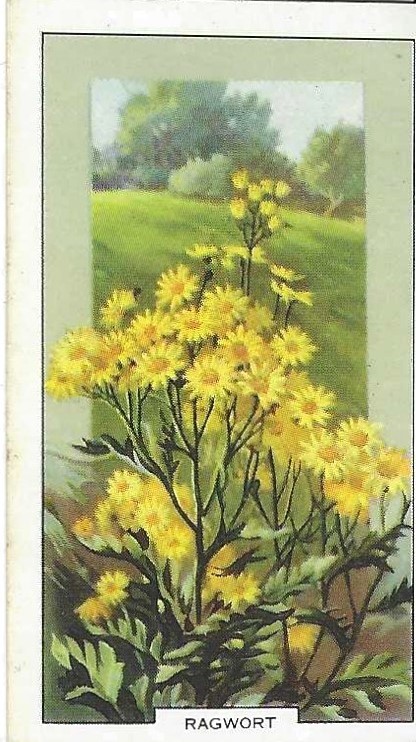
Improbable though it may seem it was widely believed in Scotland and Ireland that fairies and witches made nocturnal journeys riding on the stems of ragwort, also known as ragweed, Jacobaea vulgaris, formerly known as Senecio jacobaea.
Thus H.C. Hart in his Flora of County Donegal (1898) recorded that ragwort was known as fairy-horse, or fairy’s horse as it was ‘well-known to be the plant on which fairies ride through the air at night’.
Niall Mac Coitir, in his Irish Wild Plants: Myths, Legends & Folklore (2006) claims that in Ireland it was ‘universally believed that ragwort was used like a horse by the fairies to ride around on’. Apparently Halloween was the favourite time this activity, and ‘many stories tell of unfortunates being forced to ride around with them all night, only to wake up next morning exhausted’.
William Butler Yeats (1865-1939) recorded a story in which the local policeman, on hearing of a rumour that a local girl had been abducted by fairies, advised the villagers to burn all the ragwort in the field from which she has supposedly been taken.
 In Scotland, Robert Burns, in his 1785 poem ‘Address to the Deil’, wrote ‘Let Warlocks grim, and wither’d Hags, Tell how wi’ you on ragweed nags/They skim the muirs and dizzy crags’. Similarly, George Henderson in his Popular Rhymes, Sayings and Proverbs of the County of Berwick (1856) provides ‘On auld broom-besoms, and ragweed nags/They flew owre burns, hills and craigs’. This appears to be the first mention of the belief.
Donald Watts in his 2007 Dictionary of Plant Lore, provides much information, culled from a variety sources, relating to these beliefs. If you trod ragwort down after sunset ‘a horse will arise from the root of each injured plant, and will gallop away with you’. In the Hebrides, ‘fairies look for ragwort for shelter on stormy nights, as well as riding on it when going from island to island’. ‘As rank a witch as ever rode on ragwort’ was said to be a common saying in areas where such beliefs were held.
Images: Glasgow, July 2024; inset, cigarette card issued by Gallaher Ltd, Virginia House, London and Belfast, 1939.
30 July 2024; updated 3 August 2024

 DISCLAIMER: The cures and other uses on this site are recorded as they were received.