Honesty (Lunaria annua) has been cultivated as an ornamental in Britain since late in the sixteenth century. Of unknown origin, honesty is grown for its purple, or less frequently white, flowers and its flat, silvery seedpods, which were often used in winter flower arrangements, and for decorating fireplaces in summertime when fires were not needed. Soon after its introduction to Britain it escaped from gardens, and it is now widespread throughout lowland areas.
We are grateful to Oliver Charton, who in September 2025 drew our attention to early names given to honesty.
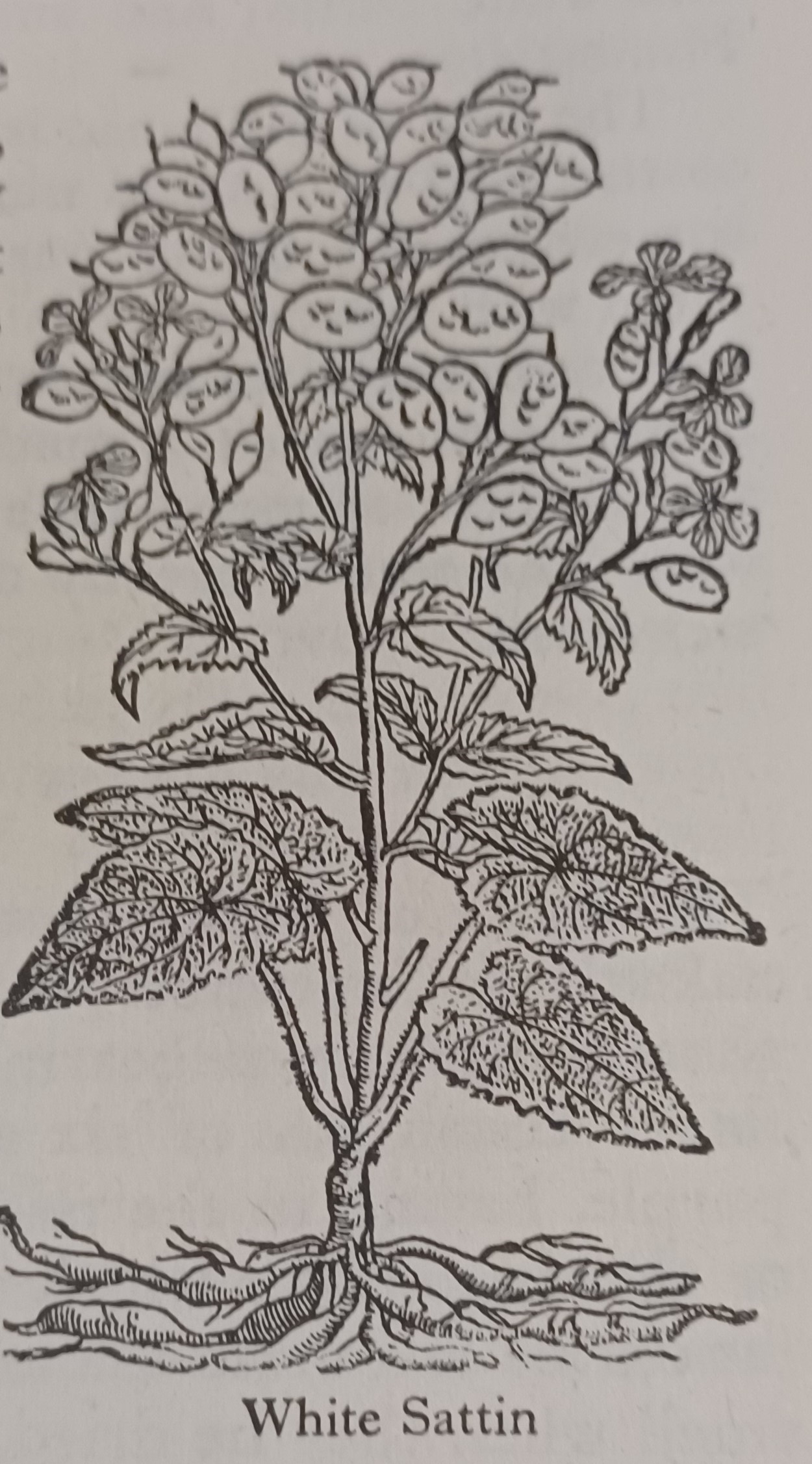 Thus according to John Gerard (1545-1612) in his Herbal, ‘we call this herbe in English Penny floure or Mony-floure, Silver Plate, Pricksong-wort; in Norfolke Sattin, and white Sattin; and among our women it is called Honestie’.
James Britten and Robert Holland in their Dictionary of English Plant-names (1878-86) also list pricksong-wort, their source being ‘Buddle MS’, presumably a manuscript left by Adam Buddle (1662-1715).
Most of these names refer to the plant’s silvery seedpods, though pricksong-wort probably needs some explanation. Here Oliver draws attention to Marcus Woodward’s Leaves from Gerard’s Herbal (1931) where on p.295 it’s noted:
‘The names White Sati, Lunaria, and Pricksong-wort are illusions to the seed-vessels. ”Pricks” were notes in written music, and a sheet of written music in Gerard’s day was known as ”pricksong”.
The name appears to derive from a visual resemblance between the plant’s mature seed structures and the notation style used in Elizabethan and early polyphonic music, known as ”pricksong”. In this style of music composers wrote out vocal parts by pricking or dotting notes onto a manuscript – each note represented by a single ink, spaced carefully on parchment. The name pricksong itself seems to come from this method of ”pricking” the page to produce musical notation.
However, according to an article in the Teesdale Mercury of 8 May 2021: ‘The fruit however has a tiny spike at the top which accounts for … [the name] pricksong-wort.’
Images: main, cultivated, Norwood Grove, London Borough of Croydon, September 2025; inset, illustration in Gerard’s Herbal.
7 November 2025.

 DISCLAIMER: The cures and other uses on this site are recorded as they were received.