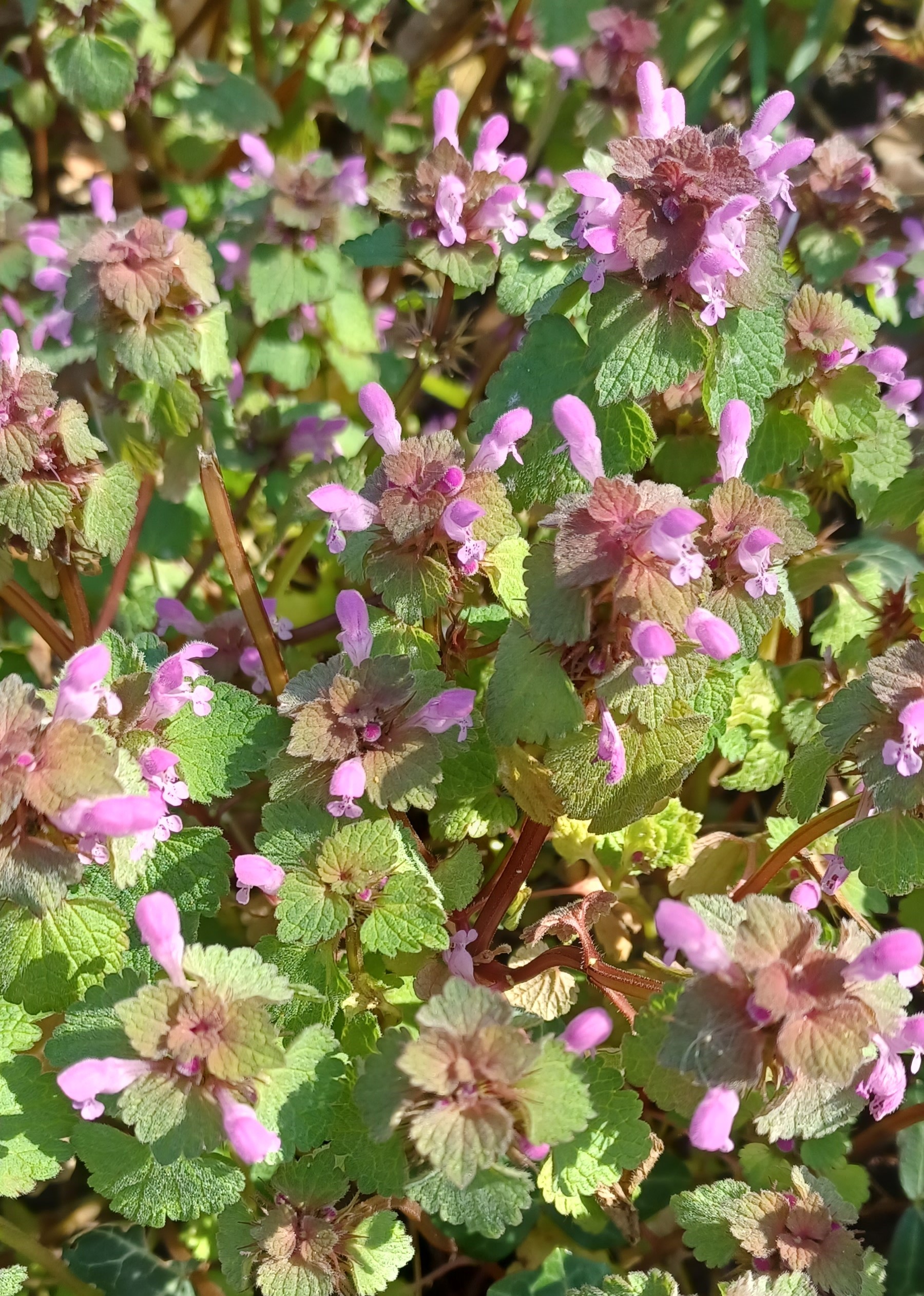
In Britain and Ireland red deadnettle (Lamium purpureum) is considered to be an archaeophyte, that is it was introduced (presumably accidentally) before AD1500. However, despite it having been around for so long, and becoming so widespread, it has attracted very little folklore. We are therefore thankful to Andy Jones who has supplied the following:
 ‘Going through the unpublished manuscripts of Hugh Davies (NLW MS6665C) in the National Library of Wales, I came across a draft letter to an unknown correspondent with folk remedies and recipes. There is some conventional herbalism (e.g. vervain [Verbena officinalis], wormwood [Artemisia absinthium], celandine [Ficaria verna], etc.) and ointments made from animal parts (seemingly gleaned from another source), but he also gives a recipe to stop nosebleeds using milfoil [presumably yarrow, Achillea millefolium]* and ‘To know whether a sick person shall recover or not, put the Red Dead-nettle into the patient’s urine when fresh, the next day observed if the herb be withered he will dye, if not withered he will recover’.’
The Rev, Hugh Davies (1739-1821) is best remembered for his Welsh Botanology (1813), which drew heavily from manuscripts left by William Morris (1705-63), who in turn gained much his knowledge from his mother, Margaret Morris (née Owen).
*See Vickery’s Folk Flora (2019), pp. 725-6, for information on yarrow being used to stop or induce nosebleeds.
As usual, comments, etc., would be gratefully received, please send them to roy@plant-lore.com
Images: main, Wandsworth Common, London, inset, Cambridge, both March 2026.
20 March 2026

 DISCLAIMER: The cures and other uses on this site are recorded as they were received.