 Seeds of over 50 tropical plants have been found on the shores of western Europe, having been carried by ocean currents from the Caribbean Islands and north-east South America. The transatlantic origin of these seeds was known by European scientists as early as 1670, but their finders on the western coasts of Britain and Ireland remained unaware of this. Consequently three of the seeds attracted folk beliefs: two members of the Pea Family, Leguminosae: Caesalpinia bonduc and Entada gigas (for information on the latter see ‘Sea Bean’ on the Material Collected page of this website), and a member of the Bindweed Family, Convolvulaceae: Merremia discoidesperma, which is discussed in this note.
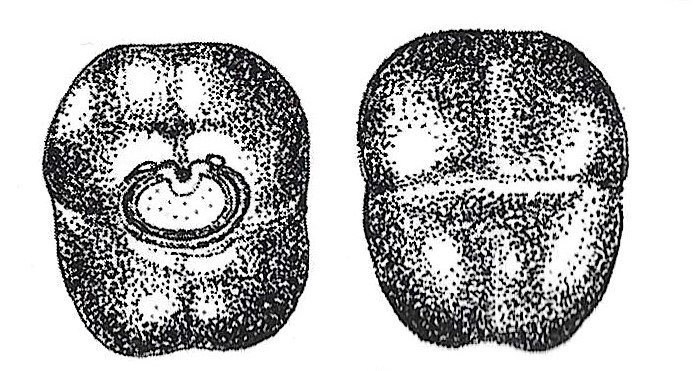 E. Charles Nelson, in his Sea Beans and Nickar Nuts (2000) describes Merremia seeds as ‘unmistakable, black, like a squat horse-chestnut with a very hardy coat, very distinctly marked on one side with a pale oval or C-like hilum, as if branded and on other side with a fainter, indented cross; circumference round to elliptical, about 2-2.5 cm across, flattened dorsally about 1.5 cm thick’.
Merremia seeds seem to have been valued mainly as amulets to ease childbirth. Thus a seed sent to Kew Gardens in 1891, was said by its donor to have been acquired about 20 years earlier, its Gaelic name meaning Mary’s Bean, and in Roman Catholic communities in the Outer Hebrides, it was believed that if it was clenched in the hand of a woman in labour it would ensure easy delivery. Such seeds could become treasured heirlooms, and the one presented to Kew had come from a North Uist woman, who said that it had formerly belonged to her grandmother [1].
In January 1893 a Merremia seed was displayed at a meeting of the Society of Antiquaries of Scotland meeting. Its sender reported that it was a ‘kind of amulet very highly prized by the people of the three Uists … which is known locally as Airne Moire (Virgin) Mary’s kidney’. Specimens which had ‘something like a cross on one side’ of them, were considered to be most valuable and sacred, being used to alleviate the pains of childbirth. Although they were ‘most in request’ amongst Roman Catholics, sometimes Protestants also used them [2].
The great collector of Hebridean folklore, Alexander Carmichael (1832-1912), noted that Merremia seeds were occasionally mounted in silver and hung around necks as talismans. ‘Every nurse has one which she places in the hand of the woman to increase her faith and distract her attention’ [presumably during childbirth].
1. W.B. Hemsley, A drift seed (Ipomoea tuberosa L.), Annals of Botany 6: 369-372, 1892.
2. Proceedings of the Society of Antiquaries of Scotland 27: 47, 1893.
3. A. Carmichael, Carmina Gadelica, vol.2: 225, 1928.
Images: main, charm made from Merremia seed, from G.F. Black, Scottish charms and amulets, Proceedings of the Society of Antiquaries of Scotland 27: 479-482, ‘the silver mounting is probably of the last [i.e. 18th] century’; upper inset, drift-seeds in J. Wallace, An Account of the Isles of Orkney, London, 1700, l-r coral-bean Erythrina sp., horse-eye bean Mucuna sloanei, Mary’s bean Merremia discoidesperma (bound as an amulet, perhaps in silver, with a heart at the centre of the crossing bands), and sea-bean Entada gigas.; lower inset, illustration by Wendy Walsh, in Nelson, op.cit.
1 November 2024

 DISCLAIMER: The cures and other uses on this site are recorded as they were received.