Peter Wyse Jackson, Ireland’s Generous Nature: The Past and Present Uses of Wild Plants in Ireland, St Louis: Missouri Botanical Garden Press, 2014.
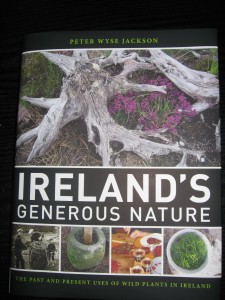 This important book by Peter Wyse Jackson, former Director of the National Botanic Gardens, Glasnevin, Ireland and currently Director of the Missouri Botanical Gardens, seeks to bring together the extensive previously published information on the uses of wild Irish plants. Although some material has been collected from informants no great effort has been made to collect new material, and no direct use has been made the extensive folklore archives held at University College Dublin. However, Wyse Jackson has searched through a wide range of publications, and has produced an impressive work.
A series of valuable chapters on plants used in construction and handicrafts, in children’s games, as food, and as symbols, etc., leads to the main part of the book, ‘An ethnobotany of wild plants in Ireland: A systematic list’. The introductory chapters stray beyond the book’s title and include histories of the cultivation of cereals, of tobacco, and other plants which are not native. The main part lists all native Irish plants according to their Latin names, regardless of whether or not they have any known uses in Ireland, and includes some naturalised species. The inclusion of plants which are not used is interesting when a plant is widespread, but when the plant is of restricted distribution and likely to be only noticed by botanists, one wonders if its inclusion is worthwhile. Once again the information provided exceeds what one expects from the book’s title, for uses recorded outside Ireland are included, sometimes with the comment there is no record of these uses in Ireland.
Although listing of plants by their scientific names might discourage some potential readers, the author’s style is personal and informal, particularly when he comes to describing dishes made from wild plants; many are described as ‘delicious’, although ‘despite studying Cochlearia [scurvy grasses] for more than five years … I never acquired a taste for this species’ [C. officinalis, common scurvy grass].
Many useful photographs are included showing how plants have been used, but the images of actual plants are rather disappointing. These are derived from two sources: a series of watercolours made by Lydia Shackleton between 1884 and 1907, many of which this reviewer, at least, finds unattractive, and photographs taken by the author, some of which are substandard: are they poor reproductions from slides?
Despite this, the book is a general ‘good read’ and will be frequently consulted by people interested in its subject matter. In his introduction Wyse Jackson records that his interest in the subject started in 2006. He is to be congratulated on bringing together such a wealth of information from such diverse sources in so short a time.
 DISCLAIMER: The cures and other uses on this site are recorded as they were received.