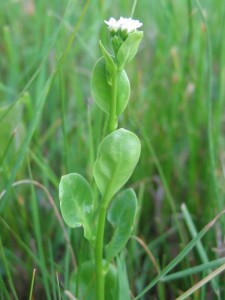
 Brookweed (Samolus valerandi) is an inconspicuous short-lived perennial which is found in damp places, particularly near the sea. Does anyone know of any folklore attached to it or know of it being used in folk medicine?
Responses
1. David Allen and Gabrielle Hatfield in their Medicinal Plants in Folk Tradition (2004) mention two uses of brookweed:
p.128, ‘the sole folk use of it traced was as an external application for eye troubles. The user in question, an Englishman living in Wales, knew the plant by the name of kenningwort …’ [information derived from Rootsey, Observations upon some of the medical plants mentioned by Shakespeare, Transactions of the Royal Medico-botanical Society, 1832-3: 92].
p.355, used to treat ‘any malady affecting swine (England, unlocalised)’ [information from A. Pratt, The Flowering Plants and Ferns of Great Britain (1850-7)].
[RV, 28 September 2013].
2. William Borlase in The Antiquities of Cornwall (1769) writes: ‘The Druids also experienced great in, at least ascribed it to, the Samolus, and gathered it in a ritual, religious manner: he that was to perform the office of gathering it, was to do it fasting, with the left hand; and whilst he was employed in the duty, was obliged not to look behind him, on any account, nor lay down the herbs any where, but in the cisterns, and chanels, where the swine and bullocks usually drink, and there they were bruised for them, and mixed with water to keep off diseases from them’. A footnote reads ‘Samolus or Marshwort, Pliny, Lib. XXIV’. According to The Cornishman, 10 August 1893: At St Levan’s Well, ‘the water pimpernel, a sacred plant of the Druids, grows here, and it was believed that to place its flowers in a well protected the cattle from disease’ [Andy Norfolk and Rupert White, September 2024].
Image: Kristian Peters, Wiki Commons.
Updated 24 October 2024.
 DISCLAIMER: The cures and other uses on this site are recorded as they were received.